

PG Seminar (CSE-BUET): From Footprints to Futures: Evaluating VLMs for Physical, Functional, and Temporal Urban Change Detection
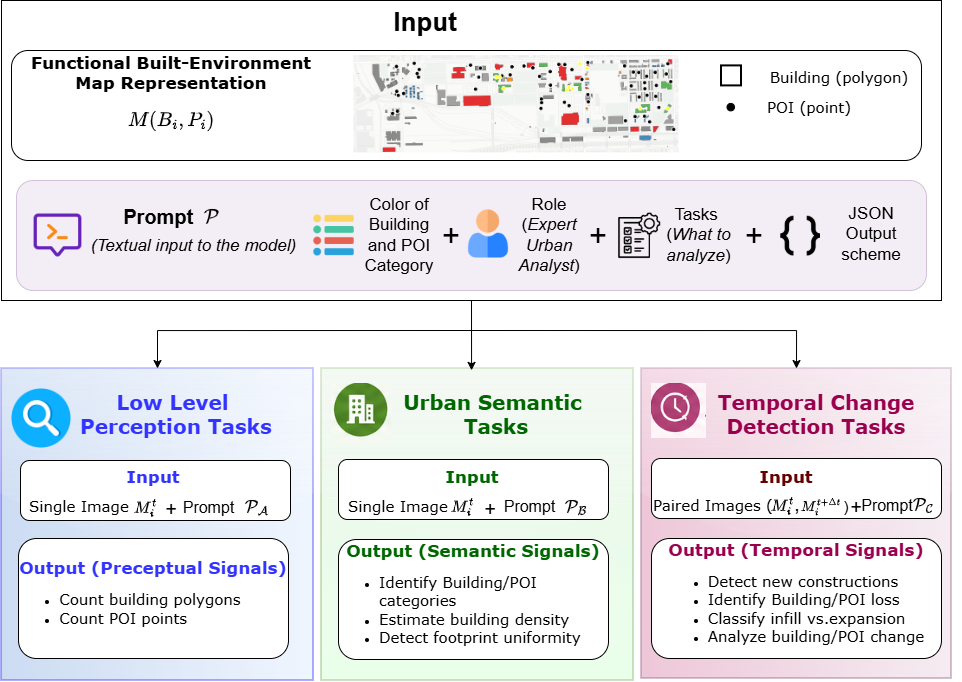
Abstract: Detecting change in the urban built environment is a fundamental challenge with wide-ranging applications across urban planning, policy-making, and socio-economic studies: from monitoring neighborhood transformation and infrastructure development to understanding patterns of displacement and economic restructuring. While conventional machine learning and deep learning approaches can identify distinct physical changes through imagery, they fundamentally lack the capacity to interpret broader contextual relationships, such as associating new construction with emerging amenities or inferring underlying socio-economic shifts from spatial patterns. The advent of Large Language Models (LLMs), in particular Vision Language Models (VLMs), presents a compelling opportunity to bridge this gap by combining visual perception with language-grounded reasoning. In this study, we evaluate the reasoning capability of VLMs in understanding urban space and their analytical ability to solve urban change detection tasks through multimodal inputs combining visual representations of building footprints and Points of Interest (POI) with textual reasoning queries. We design a suite of urban tasks spanning physical, functional, and temporal change detection, and systematically evaluate the capability of VLMs to perform these tasks. Building on this, we further assess VLMs' decision-making capability by asking them to rank urban areas based on features extracted from the preceding task groups. To validate the generated neighborhood rankings, we conduct a downstream case study comparing them against real-world gentrification trends. Extensive experiments across a range of VLMs demonstrate that while VLMs can meaningfully interpret urban map representations, smaller models struggle to capture fine-grained microscopic features. Our findings highlight the broader potential of VLMs for domain-specific urban applications, including mitigating gentrification-led displacement and optimizing transit planning.
Presenter: Tasmiah Tamzid Anannya (Std No. 04123054002)
Venue: Graduate Seminar Room