

PG Seminar (CSE-BUET): DESIGN OF CONTEXT AWARE TECH ASSISTANT FOR ELDERLY PEOPLE IN BANGLADESH THROUGH AIENHANCED VALUATION FOR FINDING TECHNOLOGY BARRIERS
Abstract: Elderly people in developing countries are being left out of digital life. There is still no settled way to find out what is stopping them. The problem is not ownership. The people in this study own smartphones and use them every day. The gap shows only when we stop asking whether they use a phone and start asking what they can actually do with it. We built a combined method to answer that question. It joins two well-known standards, Nielsen’s usability heuristics and the WCAG accessibility guidelines, with GPT-4o-mini, an AI model that reads what people write in their own words. The method reads every open answer rather than a chosen few. It also applies the two standards twice, once by a simple word-matching rule and once by the AI model. Each check can then be tested against the other. We surveyed 42 participants aged 40 to 70 across 23 districts of Bangladesh. Their skill does not fade away slowly. It stops at one clear point. What they can reach from the screen in front of them, they mostly manage. What needs a menu they rarely open, and memory of where it sits, they mostly cannot. The hard part is finding a function, not using it. These abilities are also tied to one another. A person blocked at an early step loses every step that would have followed. Help given early therefore does far more good than its size suggests. Typing in Bangla is the barrier that reaches furthest. It also does not weaken with age the way other skills do. That tells us the fault lies in the software, not in the user. Age changes how people rate themselves overall, but not what they can do task by task. One general question therefore makes this group look less able than it is. Both checks pointed to the same worst problem, help and documentation. The AI part added what the word-matching rule could not see, namely how these families ask for and give help. The survey also shows that most participants cannot type Bangla, the main language of the country. Very few use a computer, and about half turn to a family member when something goes wrong. We turned these findings into design guidelines and a list of requirements for applications meant for older users. Each one can be traced back to the finding behind it. We then built Sohayok (Sohayok- Bengali for “Helper”). It is an AI assistant that works in both languages, brings the family into the help instead of shutting them out, and adjusts itself to each user’s level. A first small trial with residents of a care home was well received. The lowest score was for using the application without anyone’s help. That is exactly the barrier the design set out to remove. The result is a method others can repeat, and answers built on what the study found.
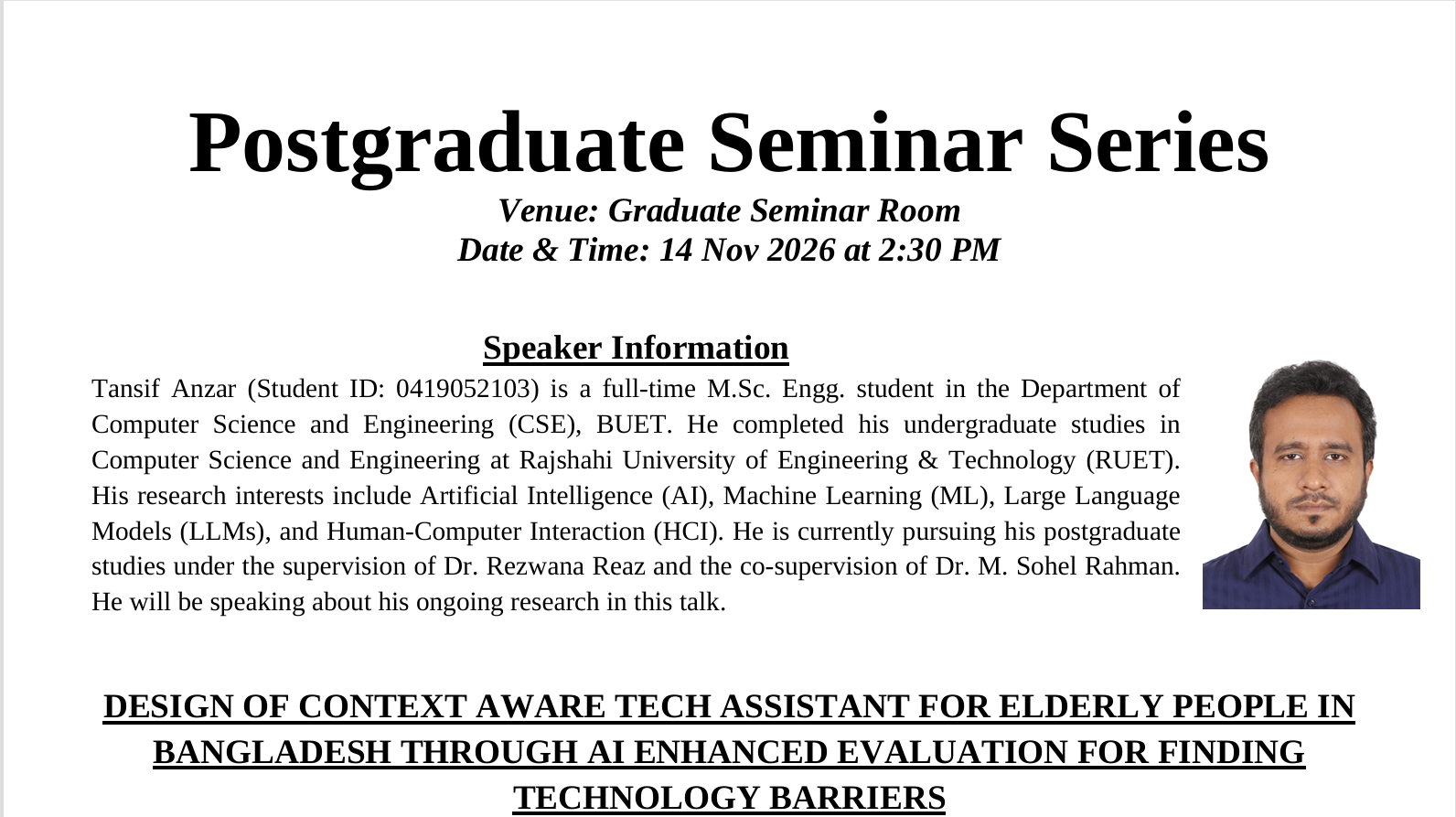
Presenter: Tansif Anzar (Student ID: 0419052103)
Venue: Graduate Seminar Room