

The Department of CSE, BUET secures five research projects worth 9.24 crore BDT under the ICSETEP RDG first round call
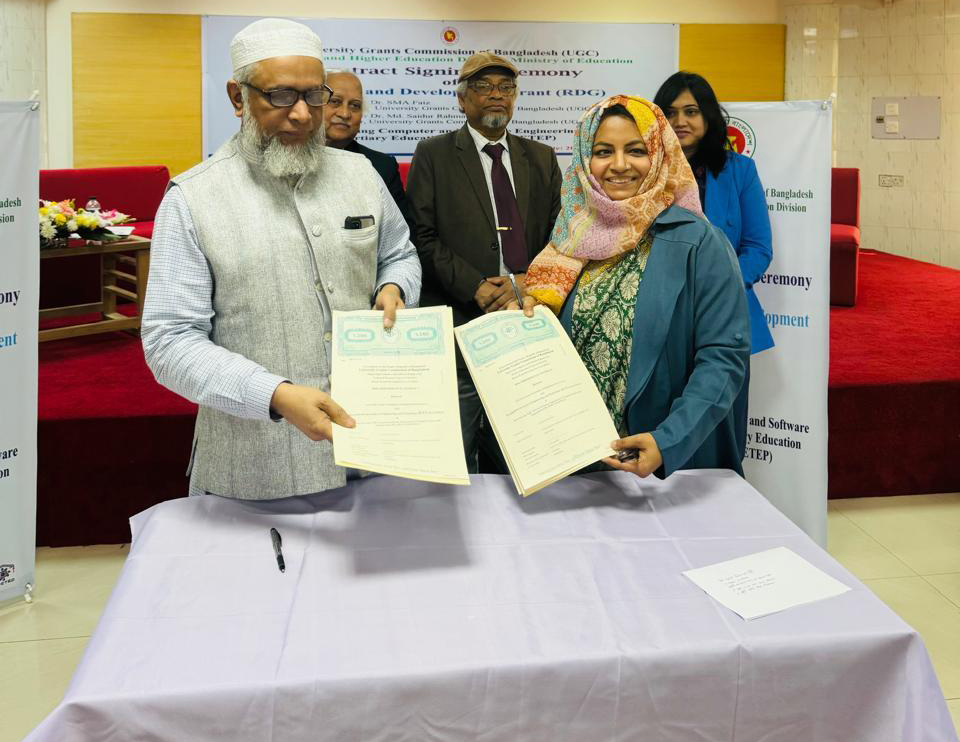
The Improving Computer and Software Engineering Tertiary Education Project (ICSETEP) is a flagship initiative aimed at strengthening tertiary-level CSE and IT education in Bangladesh to address the challenges of the Fourth Industrial Revolution (4IR). Competitive Research & Development Grant (RDG) is a significant component of ICSETEP to achieve its noble objectives. In the first round call for RDG subproject proposals (SPP), the Department of CSE, BUET submitted nine research proposals – five in the area of Academy-industry collaboration, three in Cutting-edge CSE/IT research, and one in Interdisciplinary R&D. Through a rigorous evaluation process five of these nine proposals were approved. The tripartite agreement among UGC, BUET and the respective Principal Investigators (PIs) were signed on January 20, 2026 at UGC.
A summary of the five projects is given below.
Graph Machine Learning and Networks: Theory, Methods and Applications
Area: Cutting-edge CSE/IT research
Grant: 1.10 crore BDT
PI: Dr. Sadia Sharmin, Associate Professor, CSE, BUET.
Co-PI: Dr. Atif Hasan Rahman, Associate Professor, CSE, BUET.
Co-PI 2: Dr. Akira Suzuki, Professor, Division for AI,Center for Data-driven Science and AI,
Tohoku University, Japan.
This project has been proposed in collaboration with the Division for Artificial Intelligence, Center for Data-driven Science and Artificial Intelligence, Tohoku University. This comprehensive research initiative aims at advancing the field of graph machine learning and network sciences through integration of graph neural networks with large language models, study of graph reconfiguration algorithms, and application of graph structure learning in bioinformatics. Its core mission is to develop theoretical foundations, create novel and practical algorithms, and demonstrate their power in solving real-world problems across various domains such as social networks and genomics.
The major activities of the project are organized into five synergistic areas to ensure comprehensive impact. At its intellectual core is core research & development, which focuses on advancing the theoretical foundations of graph AI, while simultaneously developing novel methods for complex network data and optimizing Reconfiguration Frameworks. These research outputs will be used to create a well-documented, open-source software library, public repositories and benchmarks to standardize evaluation and design further algorithms. Dissemination of knowledge will be achieved by publishing in top-tier scientific venues and by hosting workshops and seminars. Crucially, the project invests in research & development by supervising graduate students and enriching university courses, thereby cultivating the next generation of experts. All these efforts will be managed ensuring sustainability through strategic coordination, progress tracking, and international partnerships.
AI Enabled Building Code Compliant Structural Design Ensuring Safety Standard
Area: Academy-industry collaboration
Grant: 1.96 crore BDT
PI: Dr. Anindya Iqbal, Professor, CSE, BUET.
Co-PI: Sukarna Barua, Associate Professor, CSE, BUET.
Co-PI 2: Engr. Abdul Siddik Hossain, Head of Design and Geotechnical Engineering, Environment and Infrastructure Management Solution (EIMS) Limited.
Co-PI 3: Dr. Raquib Ahsan, Professor, CE, BUET.
This project aims to design an automated, AI-enabled solution grounded in strong theoretical and algorithmic frameworks to transform structural design and compliance checking in the civil construction sector of Bangladesh. The core objective is twofold: (i) to automatically check the compliance of building designs with applicable building codes, particularly the Bangladesh National Building Code (BNBC-2020), and (ii) to automatically generate building code–compliant structural designs directly from architectural drawings. By automating these traditionally manual, repetitive, and error-prone processes, the project seeks to significantly enhance the productivity of structural engineers while improving safety assurance in building design.
To achieve this vision, the project will develop two interrelated products using advanced machine learning techniques combined with rigorous engineering algorithms.
Product 1 focuses on automated compliance checking of architectural and structural designs against building codes. This tool will systematically verify architectural drawings, detect horizontal and vertical structural irregularities, and assess the compliance of structural detailing with code requirements related to strength, seismic performance, and constructability.
Product 2 aims to automatically generate structural designs from architectural drawings. Starting from 2D/3D CAD files, the system will translate architectural layouts into structural models, finalize structural layouts, integrate with established structural analysis software, assign loads automatically, check code compliance, and optimize the design. The generated designs will be presented through a user-friendly interface for human engineers to review, modify, and extend, ensuring practical usability and professional acceptance.
The motivation for this project arises from the critical gap in Bangladesh’s construction sector, where inadequate enforcement and checking of structural designs often lead to unsafe buildings. Current practices rely heavily on manual calculations, spreadsheets, and individual expertise, making them time-consuming, inconsistent, and prone to error. Despite rapid advances in AI-driven automation in other domains, civil construction in Bangladesh has yet to benefit from such technologies. By introducing intelligent automation for code compliance checking and structural design generation, the project aims to streamline engineering workflows, reduce turnaround times, improve design reliability, and enhance overall construction safety. Beyond its societal impact in safeguarding lives and infrastructure, the project has strong commercial potential. Following successful piloting with industry partners, the solution will be spun off through a startup incubator for commercialization in industry and government agencies. The project is expected to generate high-impact academic outcomes, including publications in reputed journals.
Progya (প্রজ্ঞা): Developing a Unified AI-Powered National Competency Framework Integrating Psychometric Modeling, Domain-adapted LLM and Personalized Learning Pathways for 21st-Century Skills Assessment and Predictive Policy Analytics
Area: Cutting-edge CSE/IT research
Grant: 1.69 crore BDT.
PI: Dr. Mohammad Saifur Rahman, Professor, CSE, BUET.
Co-PI: Md. Shariful Islam Bhuyan, Associate Professor, CSE, BUET.
Co-PI 2: Dr. M. Sohel Rahman, Member, Bangladesh Public Service Commission, and
Professor (On leave), CSE, BUET.
Project Progya is an ambitious initiative to develop Bangladesh's first AI-powered national competency assessment and personalized learning platform, targeting over 500,000 annual candidates preparing for university admission tests and Bangladesh Civil Service (BCS) examinations. The project addresses a critical national challenge: transforming the largely unproductive effort of high-stakes exam preparation into a meaningful skills development experience. Currently, millions of candidates invest substantial time in rote memorization, with over 97% of BCS aspirants ultimately unsuccessful—their preparation effort effectively wasted. Progya's core innovation lies in its integrated socio-technical architecture combining three cutting-edge components: a hierarchical "Hub-and-Spoke" competency framework developed in collaboration with UGC and BPSC; a domain-adapted Bengali-English large language model for generating expert-validated assessment items; and a Bayesian Knowledge Tracing engine that delivers personalized learning pathways targeting individual skill gaps.
The platform introduces a novel "System-Level Calibration Loop"—a privacy-preserving methodology that validates the adaptive learning system using anonymized, aggregated examination data without compromising individual privacy. Additionally, a macro-analytics dashboard will provide policymakers with unprecedented insights into national skill distributions, enabling evidence-based educational reform.
Progya directly supports Bangladesh's Smart Bangladesh 2041 vision and addresses SDG 4 (Quality Education) and SDG 8 (Decent Work). The project's sustainability plan includes B2C freemium commercialization, institutional licensing, and potential government adoption through public-private partnership models, ensuring long-term impact beyond the grant period.
BanglaEduAI: A Bengali-First Large Vision Language Model for Personalized Tutoring, Teacher Content Co-Creation, and Automated Script Marking
Area: Academy-industry collaboration
Grant: 2 crore BDT
PI: Dr. Rifat Shahriyar, Professor, CSE, BUET.
Co-PI: Tahmid Hasan, Assistant Professor, CSE, BUET.
Co-PI 2: Md. Mynul Islam, Chief Technology Officer, BacBon Limited.
Co-PI 3: Dr. Shubhra Kanti Karmaker, Assistant Professor, University of Central Florida (UCF), USA
The project will focus on researching, developing, and pilot-testing a cost-efficient, Bengali-first bilingual Large Vision-Language Model (LVLM) that: (i) delivers interactive AI-based tutoring with curriculum-aligned explanations, step-by-step problem solving, and personalized hints; (ii) co-creates high-quality teaching materials including slides, visuals, and animations in collaboration with educators; and (iii) automatically grades structured handwritten examination scripts with high fidelity to teacher-defined rubrics. Together, these capabilities aim to improve student learning outcomes, enhance teacher productivity, and enable scalable, high-quality assessment.
সবার খামার (ShobarKhamar): Building Bangladesh’s First AI-Driven Livestock Operating System
Area: Academy-industry collaboration
Grant: 2.49 core BDT
PI: Dr. A. B. M. Alim Al Islam, Professor, CSE, BUET.
Co-PI: Dr. Novia Nurain, Assistant Professor, CSE, BUET.
Co-PI 2: Hasan Ibna Akbar, Chief Technology Officer, Tirzok Private Limited.
Co-PI 3: Dr. Jannatun Noor Mukta, Associate Professor, CSE & Director, Data Science Program, UIU
The project aims to revolutionize the livestock operating system in Bangladesh through leveraging AI and cutting-edge technologies. Here, our goal is to develop contextually-appropriate and cost-effective technology interventions from 4IR and beyond for the stakeholders in the livestock ecosystem in Bangladesh, as well as enabling the adoption of our developed technologies by the stakeholders in a seamless manner. Towards that goal, we will focus on (1) promoting accessible and sustainable livestock e-farming practices, (2) develop and deploy advanced AI models for intelligent e-farming, and (3) establish and expand mass adoption of intelligent e-farming. Combinedly, the project will meet the immediate needs of the livestock industry, set the foundation for future technological advancements, and pioneering improvements in sustainable livestock practices